What is that in our yards, metering our water? Is it accurate? Is it safe? How did we end up here? The Water Utilities of Boynton Beach currently supplies 37,280 service connections. Let’s see what the records says about what is going on with their water service.
A very nice history was put together in 2012 in Resolution No. R12-038 as part of the AMR (Ride-and-Read) to AMI (Real-Time Monitoring) conversion justification.
Read the whole Resolution here: R12-038 . The history continues with:
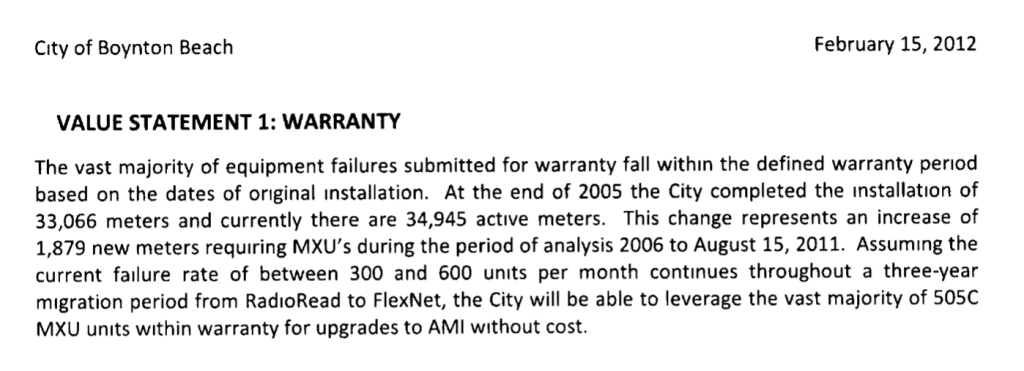
Failure rate of 300 to 600 units per month? That is 10-20 per day! With the last installation initiative 7-11 years earlier, lots of meters would be reaching the end of their life expectancy of 10 years. But the Radio units would be expected to last 20 years. Those distinctions are not made. Needless to say, if you have a 5 year installation schedule, you should expect that to repeat every 10 years if that is the life of the meter. Yes, 30,000 meter would fail at the rate of around 6,000 meters per year for 5 years. Yes, a 20 failure per day rate should have been expected and put in the budget. These are not capital items. This should be planned maintenance. And these costs should be scrutinized as routine costs of the metering system. The is no return on investment here.
At this point, I must express the opinion I have been hearing for years about these residential metering systems, not being cost effective.
The metering system manufacturer was made a sole supplier for AMI metering systems under the deal made in R12-041.
The 2012 installation initiative was completed in 2014. And 10 years later, a replacement capital project is proposed under Resolution 24-106.
We could not obtain the 2017 Resolution R17-110, but were sent the attachment to it that would have been that deal, which shows an invoice for over $400,000.
So we note that R24-106 refers to 15,000 meters that reached end of life, while the deployment was for 26,000 meters while the utility served around 36,000 service connections. So will the other 10,000 be failing over the next 5 years or so at a rate of around 6 failures per day before the failure rate goes back up to 20 per day?
Then there is the i-PERL story about being a 20 year water meter. They should have some idea if this is true as it has now been on the market for 16 years. But, who knows? These have apparently replaced the Sensus SR II meters which I am guessing are blamed as being high maintenance problems. And now, these will fix everything. Yea, as long as you install them where there is no interference and you do not have metal plumbing in your home. Oh, and if you actually use them for anything like real time monitoring, you can forget about that 20 year life.
The i-Perl get’s its added life from a different sort of lithium battery and the meter itself that works be inducing electrical current in the water being served to our homes for drinking and bathing. It’s just up to 6 millivolts in residential service, really, don’t be a baby. A little bit of electrocution won’t hurt. People are doing it all the time now for wearables and the Digitital ID won’t work without it. Get used to it. See our other posts on this subject:
The Lithium in Your Water Meter
Request to the City Commission to Opt-Out
Your New Smart Water Meter Grounding
**Water Meter Network Opt Out Request**
One more Resolution for MORE MONEY.
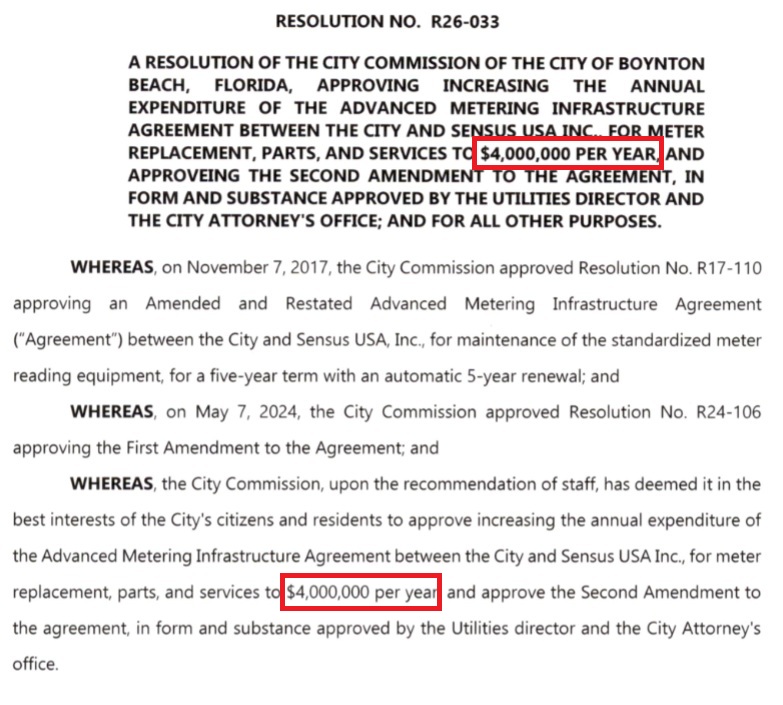
Part of this looks to be for a customer interface so you can watch how much water it takes to flush your toilet.
It looks like a plan to sample data 6 times a day versus the Ride-and-Read rate of once per month. Not real time, actually, but the battery life will not actually support that.
Here is our Public Comments Letter to the City Commission on their resolution to raise rates.
Leave a Reply